The Story of SeeIt Glass 1
Published
Feb 2, 2026
INTRODUCTION
Rejecting the appliance metaphor.
The last decade of wearable tech has been a race to build the perfect appliance: a closed, polished device that solves a handful of curated use cases. While we acknowledge the aesthetic success of products like Meta’s Ray-Ban Stories, they represent a fundamental misunderstanding of how transformative technology evolves.
We could follow the same industry playbook: design a sleek, sealed device. Polish it until it gleamed. Lock down the hardware. Control the software. Monetize the ecosystem.
OR we could do something different.
We chose the different path, not as a gesture of contrarianism, but as a calculated response to a recurring historical pattern. The most consequential shifts in computing such as the PC, the Web, the smartphone, etc, did not achieve dominance through product perfection.
They succeeded because they functioned as permissionless substrates: generative environments where developers could resolve use cases that the original architects never envisioned.
Today, smart glasses sit at a critical juncture. The hardware has achieved the necessary fidelity, the AI models have reached a threshold of utility, and the form factor has finally passed the "wearability" test. Yet, the industry is repeating its most frequent error: treating this paradigm shift as an opportunity to build a better appliance rather than a foundational platform.
Seeit Glass 1 is our rejection of the appliance metaphor. We did not set out to engineer the "perfect" pair of glasses; we set out to build the perfect hardware canvas.
Every design decision, from the modular skeleton to the open-driver vision stack, was made to ensure this hardware can be hacked, modified, and reimagined. It is a device designed for the unconstrained modification.
This is the story of our architectural philosophy: why we prioritized openness over polish, and why we believe the next era of computing belongs to platforms, not products.
THE PLATFORM THESIS
Why Seeit Glass 1 Matters
The technology sector has spent the last decade in an iterative search for the post-mobile interface. We have seen the precursors: Google Glass demonstrated the raw potential of heads-up computing, while more recently, the Meta Ray-Bans resolved the critical challenge of socially acceptable form factor. We admire and credit their work for transitioning smart glasses from a laboratory curiosity to a mainstream conversation.
However, their success has crystallized a fundamental architectural divergence that the industry has, until now, largely avoided:
Is the objective to engineer a more polished appliance, or to architect a generative substrate?
An appliance is defined by curated constraints, a closed environment serving a narrow set of use cases dictated by a single entity. Conversely, a platform is a permissionless frontier where the "killer app" is never a product of the creator’s foresight, but an emergent result of developer ingenuity.
Our philosophy is an emphatic rejection of the appliance model.
The history of computing is consistent: transformative platforms are not built; they are unleashed. * The PC did not achieve dominance because IBM designed the perfect spreadsheet.
The Web did not explode because Tim Berners-Lee predicted the streaming economy.
The iPhone did not shift the global paradigm because Apple pre-envisioned the gig economy.
These platforms succeeded because they were open enough, flexible enough, and permissionless enough for developers to imagine what came next.
We founded Seeit AI as a direct response to the industry’s pivot toward "Walled Gardens." We believe the future of augmented intelligence should not be a closed ecosystem optimized for data extraction. It should be an active, open-source foundation.
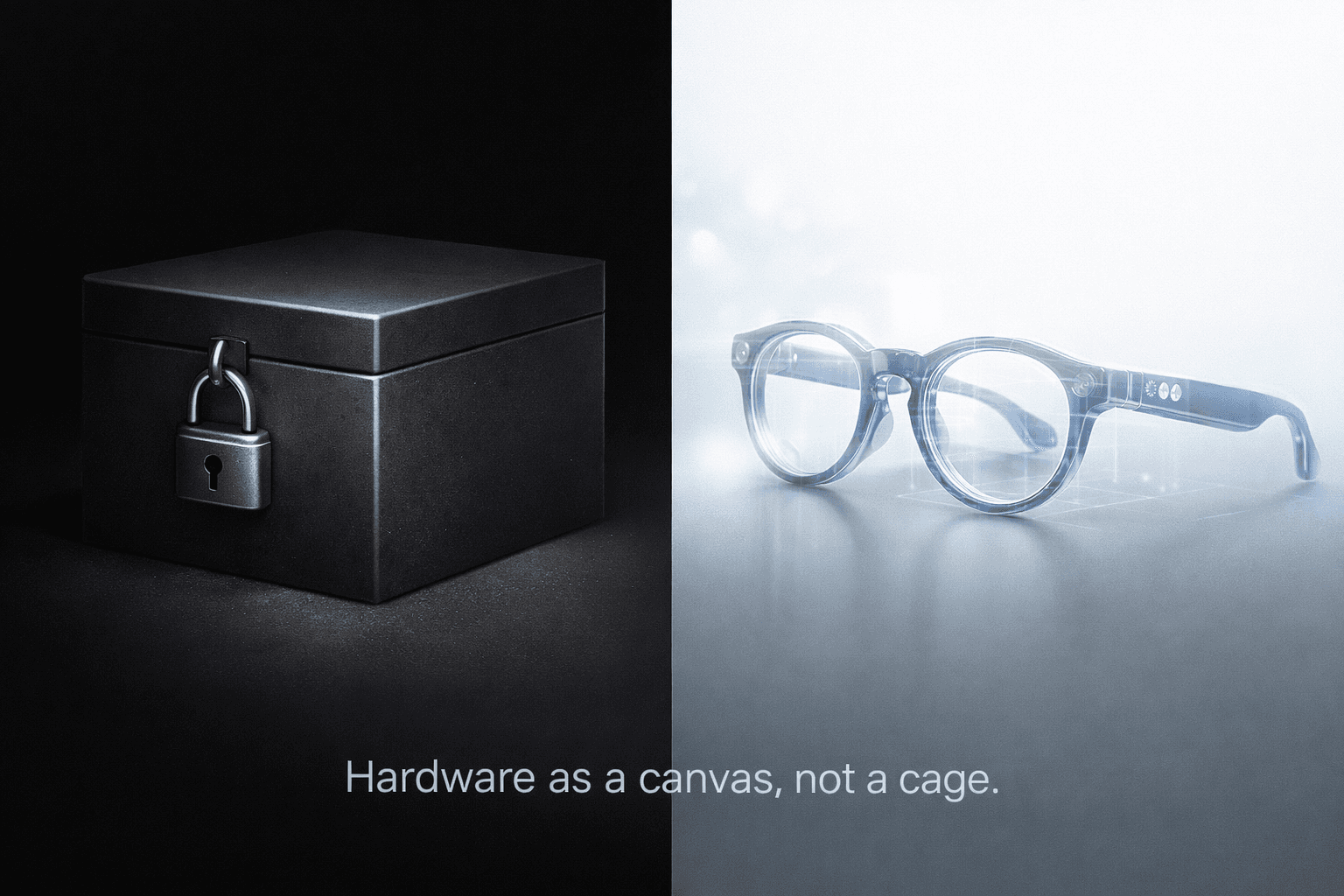
This is the grounding principle of Seeit Glass 1: Hardware as a canvas, not a cage.
Let's walk through how we built it:
THE PRINCIPLE: BUILDING THE ANDROID OF AI WEARABLE
Why our target user is the developer, not the consumer.
The conventional hardware roadmap is a pursuit of consumer delight - a cycle of polishing features until they are frictionless, yet inflexible. We have rejected this consumer-centric approach in favor of an Architectural Unlock.
We didn't ask what would please a passive user; we asked:
What do developers need to build the future?
This wasn't just a philosophical shift, but also an architectural one. Every decision for Glass 1 was filtered through a single lens: Does this help developers build, experiment, and create value?
Our goals were radically different from the rest of the industry:
Hardware as a canvas, not a cage: The device must be fundamentally open. Hackable, modular, and transparent in its construction.
AI-first, software-supreme and platform independent: Prioritize the OS and the SDK above all else. The hardware is a vehicle for Seeit OS, designed to support any AI model a developer wishes to integrate, not just our own.
From user to co-creator: Our target user is the developer. Every design decision must lower the barrier for them to build. We're not selling a product but an ecosystem.
The goal was simple: build the Android of AI wearables.
THE ARCHITECTURE
Engineering for Transparency
Building an open platform requires challenging every assumption of modern consumer electronics manufacturing. Where our competitors see intellectual property to be protected, we see a barrier to entry. Where they see a sleek, un-repairable object, we see a cage.
The Compute Module: Off-the-Shelf SoC
We intentionally avoided custom, locked-down silicon. Instead, we selected a powerful, widely documented, and publicly available System-on-a-Chip (SoC). This wasn't the path of least resistance for power efficiency, but it was the only path for openness. Developers aren’t reverse-engineering a black box; they are working with a chipset supported by a global documentation community.
The Optical Stack: Open-Driver Vision
Glass 1 features a 5MP camera, but the hardware is secondary to the access. We have written a fully open-source camera driver, granting developers raw, unfiltered access to the sensor. Whether you are building real-time translation, threat detection, or nutrition analysis, the camera is a raw primitive under your command. Note: The privacy LED is hardwired for peace of mind, but its logic resides in audited, open-source firmware.
The Audio Pipeline: Raw Mic-Array Access
Unlike devices that tether you to a single proprietary assistant, our SDK provides raw access to the three-microphone array. This allows developers to train custom hot-words, experiment with local-SLMs, or build unique spatial audio-processing engines. Our default assistant integrates ChatGPT and Claude, but we expect and encourage you to replace them.
The Skeleton: Modular and 3D-Printable
We have departed radically from traditional "unibody" design. The arms are attached via simple screws and pogo-pin connectors, making them entirely modular.
The Frame: We have open-sourced the CAD files for the front frames. Don't like our aesthetic? Print your own. Integrate it into a helmet. Build it from wood.
The Power: We utilize a standard-sized, replaceable LiPo battery. A dead battery should never mean a dead device.
"Our biggest fear wasn't a hardware flaw; it was building something a developer couldn't break. If our users aren't exercising hardware sovereignty, we've failed."
Alex Reed, Head of Engineering
THE INVITATION
Code the Future
Seeit Glass 1 is intentionally "scrappy over polished." We believe that in the race for the next platform, speed and openness will always beat a slow, closed incumbent.
We are shipping an ecosystem in a box. We have launched the hardware, but the utility will be defined by you - the tinkerers, the rebels, and the visionaries.
Open SDK: Documentation is live.
Developer grants: Applications are open for those building at the edge.
Revenue sovereignty: Our app store model is designed to favor the creator, not the platform owner.
The last generation of technology was about tapping on glass. The next is about interacting with the physical world, augmented by intelligence. We have built the tool; now it’s your turn.
Code the future. See it live.
Explore the Seeit Glass 1 schematics on our GitHub, download the SDK, and join the developer community on Discord.